

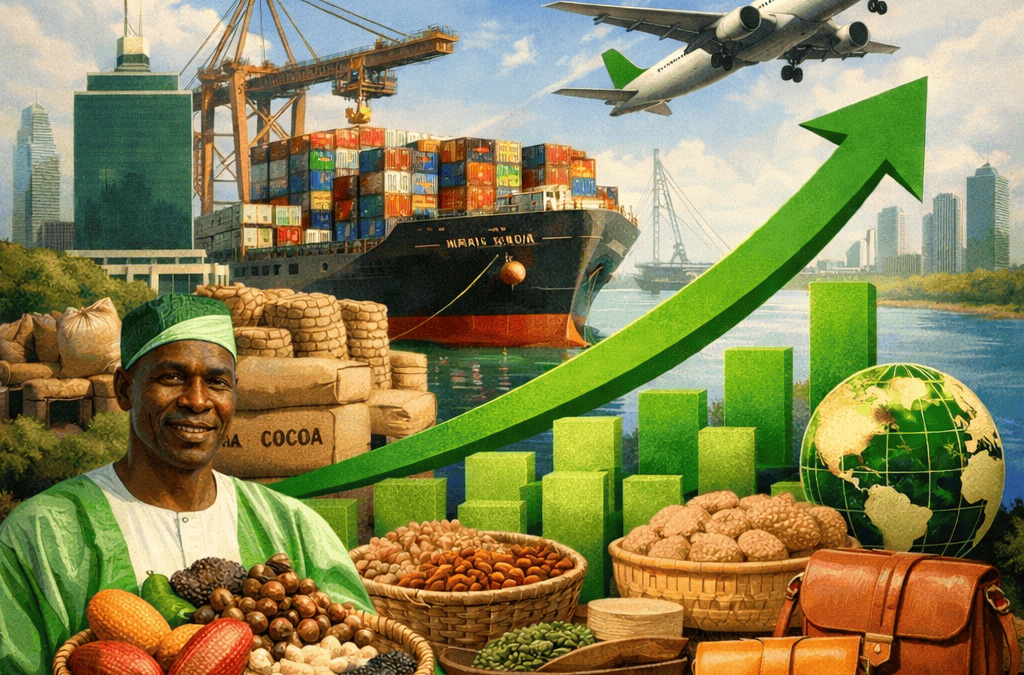
Nigeria’s Historic Non-Oil Export Performance Signals a New Era of Economic Possibility
Nonye Ayeni, ED/CEO NEPC
Nigeria entered 2025 with a clear ambition: to accelerate the nation’s transition from an oil-dependent economy to one powered by diversified, globally competitive exports. Today, as we reflect on the year’s performance, it is evident that this ambition has not only taken root—it has delivered historic results.
The non-oil export sector closed 2025 at an unprecedented high, recording US$6.1 billion in receipts—an 11.5% increase over the US$5.46 billion achieved in 2024. This is the highest formally documented non-oil export value in Nigeria’s history. Export volumes also rose sharply to 8.02 million metric tonnes, up 10% from 7.29 million metric tonnes the previous year. These numbers are more than statistics; they are a testament to the resilience, innovation, and determination of Nigerian exporters and the institutions that support them.
As I noted during the release of the 2025 performance report, this was “an impressive year” in which Nigeria “took giant strides in our efforts to diversify the economy and grow the non-oil export sector.” The results underscore the sector’s growing relevance to national development and its capacity to anchor long-term economic stability.
A More Competitive Nigeria on the Global Stage
Nigeria exported non-oil products to 120 countries, with the Netherlands emerging once again as the top destination, accounting for 17.53% of total export value. Exports to the Dutch market grew by an extraordinary 32.46%, driven by cocoa beans, cocoa butter, sesame seeds, and other high-value commodities. Brazil, India, Belgium, the United States, Vietnam, Germany, China, Switzerland, and Japan completed the top 10, reflecting Nigeria’s increasingly diversified global footprint.
Within Africa, Nigeria exported to 36 countries, generating US$478.2 million from ECOWAS markets despite geopolitical shifts in the region. Ghana and Côte d’Ivoire ranked among the global top 20 destinations, reinforcing the continent’s strategic importance and the opportunities presented by the African Continental Free Trade Area (AfCFTA).
Products and Companies Powering the Surge
Nigeria exported 281 different non-oil products in 2025, with cocoa and its derivatives leading the charge. Cocoa beans alone generated US$1.99 billion, followed by urea (US$1.29 billion), cashew nuts (US$456.9 million), sesame seeds (US$300.3 million), and gold dore (US$228.8 million). This performance reflects a gradual but meaningful shift toward value addition—an essential pillar of our long-term export strategy.
On the corporate front, fertiliser and agro-processing giants dominated. Indorama Eleme Fertilizer & Chemical Ltd led with 13.13% of total export value, followed by Dangote Fertilizer Ltd (8.41%) and Starlink Global & Ideal Ltd (8.06%). These companies exemplify the scale, consistency, and global competitiveness that Nigeria must continue to cultivate.
Strengthening the Export Ecosystem
Behind these numbers lies a deliberate strategy anchored in structural reforms, targeted interventions, and strong policy alignment with the Federal Government. The success of 2025 was made possible by the enabling environment created under President Bola Ahmed Tinubu’s Renewed Hope Agenda, which prioritises diversification and export-led growth. We also benefited immensely from the unqualified support of the Honourable Minister of Trade, Industry and Investments, Dr. Jumoke Oduwole, whose leadership strengthened inter-agency coordination and improved the operating environment for exporters.
NEPC’s own programmes played a catalytic role. The “Double Your Export” agenda expanded capacity building from farm gate to global market entry. We delivered 728 training programmes to 96,221 participants, supported SMEs in securing 210 new international certifications, and advanced value addition initiatives such as the Export Production Cluster in Kebbi State.
Financial institutions also remained central to export documentation and compliance. In 2025, 30 banks processed 19,975 NXP forms, with Zenith Bank, GTBank, and First Bank leading the pack. Meanwhile, seaports handled 94% of all non-oil exports across 20 exit points, underscoring the importance of ongoing logistics reforms.
Above all, our exporters deserve the highest commendation. As I stated in the report:
“I recognise the doggedness and determination of our exporters who, despite the different headwinds and challenges, were able to contribute significantly to the growth of non-oil exports in Nigeria.”
Their resilience is the backbone of this success story.
A Confident Outlook for 2026
Looking ahead, the momentum is unmistakable. NEPC’s priorities for 2026 include deeper capacity building, expanded production clusters, reduced export rejects, broader SME participation, enhanced value addition, and stronger governance in the solid minerals sector. The implementation of the Nigeria–UAE Comprehensive Economic Partnership Agreement (CEPA)—which eliminates tariffs on 7,315 Nigerian products—will open new frontiers for market expansion.
As I have said, “2026 promises to be a great year for non-oil export.” Our commitment is unwavering: to drive up the volume and value of Nigeria’s non-oil exports, expand market access, and ensure that the sector becomes a cornerstone of sustainable and inclusive economic growth.
Nigeria has entered a new era of export possibilities. The foundation is strong, the trajectory is clear, and the opportunities ahead are immense. The task before us is to build on this momentum—boldly, strategically, and collaboratively.
Recent Comments